How to choose the right motocross tires
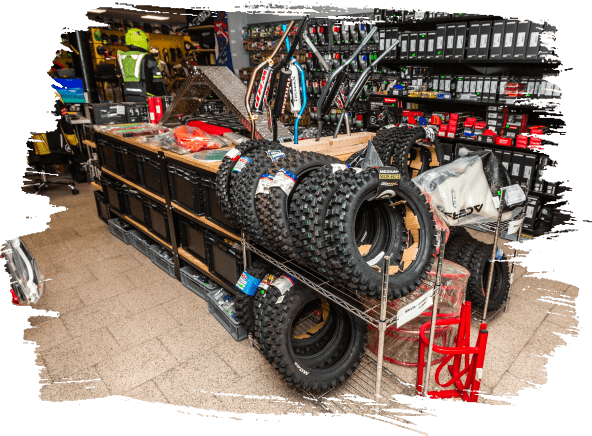
When choosing the right tires for a motorcycle, the most important factor is the terrain on which the motorcycle will be ridden. Motorcycle tires are usually sold separately, and each rider chooses their own set of tires according to their preferences. Off-road tires differ in terms of material composition and tread pattern. Tire manufacturers indicate the material composition with a colored stripe. The tread pattern, or lugs, is another distinguishing feature of motorcycle tires. We must not forget the correct tire size. For off-road motorcycle tires, it is not the brand of the motorcycle that matters, but essentially the size of the motorcycle.
Tires by size
Small motorcycles with a displacement of 50 cm3 usually have 12" front tires and 10" rear tires.
Larger motorcycles with a displacement of 65 cm3 have 14" front tires and 12" rear tires.
Motorcycles with a displacement of 85 cm3 are usually built on large wheels, so the front tire is 19" and the rear tire is 16".
Large motocross motorcycles with a displacement of 125 cm3 and above have 21" front tires and 19" rear tires.
Enduro off-road motorcycles need front tires that are the same as motocross tires, i.e., 21", and rear tires that are 18".
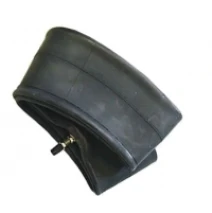
Even the smallest riders can use extra-strong inner tubes or
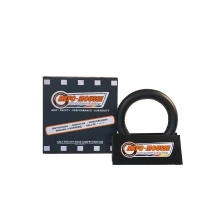
MOUSSE, with MOUSSE available from 10" to 21".
.jpg)
Source: internal database
Stripes on tires
A green stripe indicates a soft compound; other manufacturers may label this compound as "soft."
A blue or yellow stripe indicates a medium compound, i.e., the material is medium.
A red stripe indicates a hard compound.
Check out the selection for young racers
Off-road tires
Motocross tires are selected according to the surface of the motocross track. If the track is dry and hard as rock, it is good to choose tires with a denser tread pattern and closely spaced spikes, as such tires have better contact with the track surface. Conversely, if the track is sandy, which is not very common in the Czech Republic, tires with a "paddle" tread pattern are used. The ideal motocross track surface is not very common; mud is more common. For both of these surfaces, tires with a very sparse tread pattern are suitable, as they remove mud from the tire surface well.
Off-road motorcycle tires are prone to punctures, and a punctured inner tube means the end of the race or fun. A classic inner tube can be replaced with a thick-walled inner tube, which is not so easy to puncture. Or you can choose a more expensive and maintenance-intensive option, namely MEFO mousse.
How to inflate tires correctly?
For road motorcycles, follow the manufacturer's specifications. Usually, the front tire has a pressure of 2.5 bar and the rear tire 2.9 bar. For off-road tires, whether for motocross or enduro, there is no optimal pressure. It depends on personal preference—some people prefer a pressure of 0.9 bar, others 1.1 bar.
When to put on new tires?
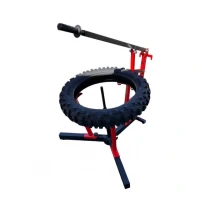
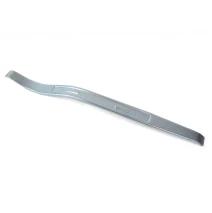
Road motorcycles have a minimum tire tread depth of 1.6 mm, as required by law. There is no minimum tread depth for off-road motorcycles, but the tread must be high enough for the tire to "work" and not slip. Tires on motocross and enduro motorcycles can lose their tread and crack when riding off-road. Once this happens, it is too late to replace them. You can change motocross and enduro tires yourself, but road tires are usually changed by experts at a service center.
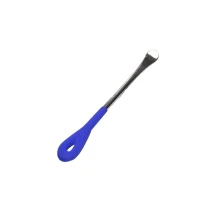
Motorcycle tire changing tools
Quick repair of motorcycle tires
Motorcycle tires are prone to punctures in the field, and a punctured inner tube means the end of the race or fun, as off-road tires cannot be repaired. A classic inner tube can be replaced with a thick-walled inner tube, which is not so easy to puncture. Or you can choose a more expensive and maintenance-intensive option, namely MEFO mousse. For quick repairs to road motorcycle tires, you can use
Tyre Repair.
.jpg)
Source: Acerbis manufacturer https://marketing.acerbis.it/gallery/10053-dual-road/10326-shoes/249-x-stradhu-boots

 WEAR SALE
 PLASTICS SALE
  cycling cheap


 airbox and airbox covers
 UNIVERSAL FENDER
 NUMBER PLATE
 LOVER FORK COVERS
 INGNITION & CLUTCH COVER
 SWINGARM PROTECTION
 TANK COVER
 Front disc covers
 MUD FLAP
 SKID PLATES
 FRAME PROTECTOR
 HEADLIGHT MASK
 Radiator grilles
 TAIL LIGHT FENDER
 SIDE PANELS
 FRONT FENDER
 RADIATOR SCOOPS
 Chain guide
 REAR FENDER
 BRAKES
 BRAKE DISCS & BOLTS
 BRAKE PADS
 CALIPERS & BRAKE PUMPS
 BRAKE PEDAL
 BRAKE HOSE
 ENGINE PARTS
 GASKETS & SEALS
 CARBURETOR
 BEARINGS
 OIL PLUG
 PISTON SETS
 TIMING CHAINS
 CLUTCH & ACCESSORIES
 Nozzles
 CYLINDER HEAD
 engine covers
 WATER PUMP
 CONNECTING ROD KIT
 FILTERS
 AIR FILTER COVER
 OIL FILTER
 NET AIR FILTER
 AIR FILTER
 FUEL FILTER
 HANDGUARDS
  OPEN
OPEN Open universal
 CLOSED
 CLOSED UNIVERSAL
 HANDGUARD ACCESSORIES
 RADIATOR
 RADIATORS
 RADIATOR BRACES
 RADIATOR HOSES
 WHEELS
 BEARINGS
 SPOKES
 SPACERS
 NUTS
NUTS WHEELS & RIMS
 TPS SENSOR COVER
 SWINGARM & LINKAGE
 LINKAGE KIT
 KETTENBLOCK
 LINKAGE COVERS
 CABLES
 TANKS
TANKS ADDITIONAL TANKS
 TANK CAPS
 TANK VALVES
 TANK PARTS
 LEVERS AND PERCH
 GRIPS
GRIPS THROTTLE TUBE
 GRIP ACCESSORIES
 SHIFT LEVERS
 CHAIN SET
 FRONT SPROCKETS
 SPROCKETS & SCREWS
 CHAINROLLER
 SPROCKET COVERS
  Accessories for chain wheels
 STEERING
 HANDLEBARS
 CLAMPS
 STEERING NECK
 CROSSBAR PAD
 HANDLEBAR ACCESORIES
 SEATS
SEATS SEATFOAM
 SEAT COVER
 FOOTPEGS
 FOOTPEGS
 SPRINGS & PINS
 PROTECTORS
 HEADLIGHTS
 SPARK PLUG
  BOLT SETS
 BRAKE BOLT AND SPROCKET SCREW
 PLASTIC SCREWS
 SEAT
SEAT SHOCK ABSORBERS
 SIMERINGS & DUSTERS
 SET OF BUSHINGS
 bleeder screw
 front shock absorber covers
 rear shock absorber covers
 REAR SHOCK ATTACHMENT
 LAUNCH HELPER
 EXHAUST
 EXHAUST PROTECTION
 COTTON WOOL
 PLUGS
PLUGS HEAT-RESISTANT FOIL
 CONNECTING RUUBBER
 SPRINGS
 REPAIR KITS
 SILENTBLOCK
 Adventure
 rider equipment
 MOTOCROSS/ENDURO
 Acerbis carbon
 Acerbis Airstrike-X
 Acerbis T711
 Acerbis Linear
 Acerbis Whoops
 FULL FACE
 FLIP-UP
 OPEN
OPEN JUNIOR
 RETRO
RETRO ACCESSORIES
 GOGGLES
 GLASS, TEARS OFF...
 PROTECTION
 CHEST PROTECTORS
 NECK BRACES
 KIDNEY BELTS
 ELBOW PROTECTORS
 KNEE GUARDS
 BACKBONE
 JUNIOR
 children’s chest protector
  SOFT PANTS
 BOOTS
BOOTS travel
 ANKLE
ANKLE ENDURO
 JUNIOR
 soles and more
 Wellies
 on a scooter
 JUNIOR
 JACKETS
 ENDURO
 women
women PANTS
PANTS ENDURO
 TEXTILIE
  jeans
jeans summer
 GLOVES
 WINTER
 ENDURO
 summer
 WATERPROOF
 women's
  glove liners
 SOCKS
SOCKS WATERPOOF GEAR
 VESTS
VESTS THERMO UNDERWEAR
 THERMO T-SHIRTS
 THERMO PANTS
 THERMO KNEE SOCKS
 leisurewear
 Headwear
 T-SHIRTS
 trika-uni
 Children's T-shirts
 Mini T-shirts
 SWEATSHIRT
 leisure jackets
 FREE TIME SHORTS
 Sweatpants
 Casual shoes
 HOODS
HOODS SCARF
SCARF TOOLS
TOOLS Wrenches, hooks, screwdrivers
 TIRE LEVERS
  CHAIN BREAKERS
 Preparations for shocks
 Preparations for wheels
 Engine preparations
 Preparations for bearings
 OTHER MOTO TOOLS
 GRAPHICKITS, NUMBERS
 Wheel changers
 Canisters, measuring cups
 TRANSPORT
 CARPETS
 MOTORCYCLE COVERS
 HOURMETER
 helpers for track and training
 STAND
STAND HYDRATION BAGS
 PIT BOARD, MARKER
 MOTO LUGGAGE
 BACKPACKS
 WAIST PACKS
 VOUCHERS
 STAND
STAND FORK OIL
 AIR FILTER OIL
 CHAIN LUBES
 COOLANT FLUID
 BRAKE FLUID
 CLEANER AND IMPREGNATION
 additives
 MEFO MOUSSE
 10"
10" 12"
12" 14"
14" 16"
16" 17"
17" 18"
18" 19"
19" 20"
20" 21"
21" MOUSSE GEL
 TUBE FOR MOTORCYCLE
 4"
4" 5"
5" 6"
6" 8"
8" 9"
9" 10"
10" 12"
12" 13"
13" 14"
14" 15"
15" 16"
16" 17"
17" 18"
18" 19"
19" 21"
21" 22"
22" 23"
23" MX TIRE
 10"
10" 12"
12" 14"
14" 15"
15" 16"
16" 17"
17" 18"
18" 19"
19" 20"
20" 21"
21" ENDURO TIRE
 ROAD TIRE
 15"
15" 23"
23" 4"-6,5"
 8"
8" 13"
13" HALTERS
 Massage products
 Pre-sports preparations
 Post-sports preparations